织光成锦:萨德伯里丝绸的百年温柔与坚守
Sudbury is a major silk manufacturing centre with five local firms involved in the production of a wide range of quality fabrics. However, silk manufacture has been established here a mere 200 years or so, whilst textile manufacturing has been established in the town since at least the 14th century. Then it was weaving woollen cloth and the fine medieval timber-framed merchant’s houses in Stour Street were built with the wealth that it created. When demand for the heavy woollen broadcloth declined in the 16th century the weavers of Sudbury turned to producing lighter fabrics – bays, says, crepes and cotton bunting – in the 18th century much of the bunting was supplied to the Royal Navy for flags.
萨德伯里是英国主要的丝绸制造中心之一,目前有五家当地企业从事各类高档面料的生产。然而,丝绸制造在这里扎根不过两百余年,而这座城镇的纺织历史至少可以追溯至14世纪。那时,镇上主要织造羊毛布料,圣彼得街上那些精美的中世纪木质框架商宅,正是羊毛贸易所积累财富的见证。16世纪,厚重的羊毛宽幅呢绒市场需求下滑,萨德伯里的织工们开始转向生产lighter fabrics——贝斯毛呢、塞尔呢、绉纱以及棉质旗布。到了18世纪,大量旗布被供应给皇家海军,用于制作舰船旗帜。
THE ORIGINS OF THE INDUSTRY IN ENGLAND
英格兰丝绸业的起源
Silk making began in China but by the late Middle Ages the knowledge had been brought back to Europe where France and Italy became the leading producers. In 1609 King James I made an effort to stimulate silk making in England by encouraging the planting of mulberry trees, knowing that silkworms fed on the leaves. Unfortunately his knowledge did not include the fact that it fed on the leaves of the white mulberry, not the black variety which his government was supplying for planting, and the attempt proved abortive.
丝绸制作技艺起源于中国,至中世纪末期传入欧洲,法国和意大利成为主要生产国。1609年,英王詹姆斯一世得知蚕以桑叶为食,便鼓励种植桑树,试图在英格兰推动丝绸生产。遗憾的是,他并不知道蚕食用的是白桑叶,而政府提供并推广种植的却是黑桑,这一善意的尝试最终无果而终。
However, by the end of the 17th century another monarch’s religious bigotry succeeded where James’s well meaning efforts had failed. In 1685 the Catholic king of France, Louis XIV, revoked the Edict of Nantes which guaranteed the religious and civic rights of Huguenots-his subjects who followed the Protestant faith. All now had to convert to Catholicism or face persecution. The result was a mass exodus of some 500,000 of his Huguenot subjects into neighbouring countries, taking with them their wealth, arts and skills, including silk weaving. Many came to Spitalfields in London, and so the silk industry was established in England.
然而,到了17世纪末,另一位君主的宗教偏执却达成了詹姆斯一世未能实现的愿望。1685年,法国天主教国王路易十四废除了《南特敕令》,该敕令曾保障其信奉新教的臣民——胡格诺派信徒——的宗教与公民权利。敕令废除后,所有胡格诺派信徒要么改宗天主教,要么面临迫害。结果导致约五十万胡格诺派信徒大规模流亡邻国,他们带走了自己的财富、艺术和技能,其中就包括丝绸织造技艺。许多人来到伦敦的斯皮塔菲尔德定居,英格兰的丝绸产业由此奠基。
SILK COMES TO SUDBURY
丝绸来到萨德伯里
Silk weaving came to Sudbury about 100 years later. By then the industry in Spitalfields was well established but plagued by frequent industrial disputes between masters and men, particularly over wages. In 1774 the local magistrates in Spitalfields decided to act and began the first of a series of efforts to regulate the local silk industry, deciding to enforce wage levels on masters and men alike. Many masters then began to move production to country areas within easy reach of London but beyond the interference of the London magistrates.
大约一百年后,丝绸织造技艺传入萨德伯里。彼时,斯皮塔菲尔德的丝绸产业已根基稳固,但劳资纠纷频发,尤其是工资争端,令行业困扰不已。1774年,当地地方法官决定介入,开始尝试对丝绸行业进行规范,首项举措便是强制雇主与工人双方遵守既定工资标准。许多雇主因此将生产迁往伦敦周边、但又不受伦敦地方法规管辖的乡镇地区。
And so silk weaving arrived in towns such as Haverhill, Glemsford and Sudbury. Here there were many skilled textile workers who were happy to work at wages that were higher than they could obtain weaving the traditional fabrics but still only two thirds of what the silk masters would have to pay in Spitalfields.
于是,丝绸织造业便落户于哈弗希尔、格莱姆斯福德和萨德伯里这样的城镇。当地不乏技艺娴熟的纺织工人,他们很乐意接受比织造传统布料更高的工资——尽管这仍只有斯皮塔菲尔德丝绸厂主所需支付工资的三分之二。
WEAVERS’ COTTAGES
织工小屋
By 1844 there were four silk manufacturers and some 600 silk looms in Sudbury although about half the looms were idle ‘in consequence of the general depression of that year.’More silk manufacturers arrived in the following years but it must be remembered that silk weaving was still a hand process which could be carried out within the domestic system. This explains the long terraces of three storey weavers’ cottages which are still such an interesting feature of the townscape. Many rows were demolished in the 1960s and 70s but good examples can still be seen in Melford Road, New Street, East Street, Station Road and Cross Street.
到1844年,萨德伯里已有四家丝绸制造商和约六百台丝绸织机,不过,“受当年普遍经济萧条影响”,近半数织机处于闲置状态。此后数年,更多丝绸制造商相继进驻。但需注意的是,当时的丝绸织造仍属手工操作,可在家庭手工业体系内完成。这解释了为何镇上至今留存着那些三层联排的织工小屋,成为当地独具特色的景观。许多这样的排屋在二十世纪六七十年代被拆除,但在梅尔福德路、新街、东街、车站路和十字街,仍可寻见保存完好的范例。
The ground floor was living space, the top floor for sleeping but the middle floor was the shop, a large undivided working area with large windows front and back to admit maximum light. In the centre of the room silk thread was hand wound onto swan’s quills or paper tubes which were inserted into shuttles. The women usually did this task whilst the men operated the loom. The loom was set up at right angles to the window so the light fell across the warp. Given this arrangement, it was not uncommon to see windows on the shop floor with missing panes of glass where a fly shuttle had flown off the loom through the window and landed in the street below! In poor light the weaver would light the oil lamp which hung from the loom beam – most cottages had neither gas nor electricity.
这些小屋的底层为生活区,顶层是卧室,而中间一层则是“作坊”——一个宽敞通透的工作间,前后开有大窗以最大限度地引入光线。房间中央,蚕丝线被手工缠绕到天鹅羽管或纸管上,再装入梭子。这道工序通常由女性完成,男性则操作织机。织机与窗户呈直角放置,以便光线斜射在经线上。正因如此,作坊层的窗户上常能看到缺了几块玻璃——那是飞梭脱机而出,穿过窗户坠落到街道上留下的痕迹!光线不足时,织工会点亮挂在织机横梁上的油灯——当时多数小屋既无煤气也无电力。
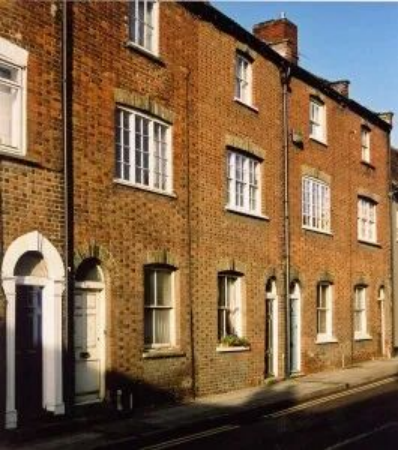
Weavers’ cottages in Cross Street
十字街的织工小屋
The system had many advantages, not least a feeling of independence and the freedom, particularly for a woman to combine winding with other household tasks. However, there was a downside as well. The weaver was totally dependent on his employer who supplied the warp and skeins of weft yarn and then paid for the finished roll of cloth. The employer might dock his wages if he found imperfections in the weaving. Employment might dry up altogether if there was a recession in the industry and even if work was plentiful the weaver might have to wait to be paid until the roll was finished although he might negotiate some payments on account. Perhaps it was not surprising that local handloom weavers had a reputation for ‘going on the beer’ when they did have money in their pockets!
这种家庭作坊模式有许多好处,最重要的是让织工感受到一份独立与自主,尤其对女性而言,她们可以一边绕线一边兼顾其他家务。然而,不利之处同样存在。织工完全依附于雇主——雇主提供经线和成绞的纬纱,并支付织成布匹的报酬。若织造出现瑕疵,雇主可能克扣工资。行业萧条时,可能根本无活可干;即便活计充足,织工也常要等到整匹布织完才能拿到工钱,尽管有时能预支部分款项。如此看来,当地手摇织机织工们手头一有钱就“喝个痛快”的名声,也就不足为奇了。
THE DEVELOPMENT OF ‘MANUFACTORIES’
“制造工场”的兴起
The employer also had his difficulties with the system. It was difficult to train new weavers and to ensure the quality of the finished fabric. Some employers therefore centralised production in a building where they could provide training and supervise work on the looms. This trend accelerated with the introduction of wider hand looms and the Jacquard loom for weaving intricate velvets and damasks; both types of loom were too big to fit into a weaver’s cottage.
雇主们对这种分散的生产模式也颇感头疼。培训新织工、保证成品质量都颇为困难。因此,部分雇主开始将生产集中到一处,以便统一培训工人并监督织造过程。随着更宽幅的手织机以及用于织造复杂天鹅绒和花缎的提花织机的引入,这一趋势进一步加快——这两种织机体积过大,无法安置在织工的小屋内。
Nineteenth century documents refer to silk ‘manufactories’ in the town. Some of these were no more than residential houses which were used as warehouses. The weavers only went there to collect their raw materials and to return the finished roll of cloth. A good example is 49A North Street . Other ‘manufactories’ were large work shops with a number of hand looms. Most of these have disappeared although the ground floor of one survives at the back of the former manager’s house at 41 Melford Road.
十九世纪的文献记载了镇上的丝绸“制造工场”。有些不过是充当仓库的住宅,织工们仅去那里领取原料和送回织好的布匹,北街49A号便是一例。另一些则是设有众多手织机的大型工坊。这些工坊大多已不复存在,但在梅尔福德路41号——原经理住宅后方,仍保留着一处工坊的底层。
Two much larger former silk ‘manufactories’ survive which are closer to most people’s idea of a factory, representing attempts to pull together the various stages of production under one roof including silk throwing (spinning), warping, dyeing and weaving.
另有两座规模更大的前丝绸“制造工场”留存至今,它们更符合一般人心目中“工厂”的形象,体现了将捻丝、整经、染色和织造等多个生产环节集中于一处的尝试。
Employment in the silk industry reached a peak in the 1850s when about 2,000 silk throwster, dyers and weavers were employed locally. However, a number of firms failed to survive in the decades following the Cobden Free Trade Treaty in 1860; this allowed competition from cheaper French products. The firms that survived this and later recessions in the industry did so by focussing on the quality end of the market and by specialising in a niche market – in the late 19th century a number of firms specialised in silk fabric for parasols and umbrellas.
十九世纪五十年代,丝绸产业就业达到顶峰,当地约有两千名捻丝工、染工和织工受雇于此。然而,1860年《科布登自由贸易条约》签订后,数十年间多家企业未能挺过冲击——该条约允许价格更具优势的法国产品进入英国市场竞争。那些挺过此次危机及后续行业衰退的企业,靠的是专注于高端市场和利基产品:十九世纪末,数家企业专门生产用于阳伞和雨伞的丝绸面料。
THE INDUSTRY TODAY
今日丝绸
Today, five silk firms carry on this proud and long history of textile manufacture in Sudbury and we can proudly claim to be the silk capital of England with an estimated 110 metric tons of China silk coming annually into the town.
如今,五家丝绸企业延续着萨德伯里悠久而自豪的纺织制造传统。我们可自豪地宣称,这里是英格兰的丝绸之都,每年预计有一百一十公吨的中国生丝输入此镇。
内容来源|Sudbury Virtual Museum
转载请注明来源:世界丝绸网